
Claiming Type 2 Diabetes Secondary to Obstructive Sleep Apnea
Claiming Type 2 Diabetes Secondary to Obstructive Sleep Apnea: What Veterans Need to Know
Schedule A Free Phone Consultation: Discuss Your Case with Dr. Allen
Many veterans know that obstructive sleep apnea can cause fatigue, poor sleep, morning headaches, irritability, and difficulty concentrating. What many veterans do not realize is that obstructive sleep apnea may also affect blood sugar, insulin resistance, weight regulation, inflammation, and long-term metabolic health.
For veterans who are already service connected for obstructive sleep apnea and later develop Type 2 Diabetes Mellitus, it may be possible to file a VA disability claim for diabetes as a condition secondary to obstructive sleep apnea. This type of claim usually requires more than simply showing that both conditions exist. The veteran must present a clear medical explanation showing how the service-connected sleep apnea caused, contributed to, or aggravated the diabetes.
That is where a well-written diabetes nexus letter can be important.
This article explains how VA secondary service connection works, how Type 2 Diabetes is rated by the VA, how obstructive sleep apnea may contribute to diabetes, and what veterans should understand before filing a secondary claim.
What Is Secondary Service Connection?
Secondary service connection means that a veteran has a disability that was caused or aggravated by an already service-connected condition.
For example, a veteran may already be service connected for obstructive sleep apnea. If that sleep apnea contributes to the development or worsening of Type 2 Diabetes Mellitus, the veteran may be able to claim diabetes as secondary to sleep apnea.
This is different from a direct service connection claim. In a direct claim, the veteran is usually arguing that the condition began during service, was diagnosed during service, or was directly caused by an in-service event, injury, exposure, or illness. In a secondary claim, the focus is different. The question becomes whether the already service-connected disability medically led to, contributed to, or worsened the new condition.
Veteran’s Pearl: A secondary claim does not always require proving that diabetes started during active duty. The central question is whether a service-connected condition, such as obstructive sleep apnea, caused or aggravated the diabetes after service.
Learn more about secondary service connection here: What Is Secondary Service Connection?
Can Type 2 Diabetes Be Claimed Secondary to Obstructive Sleep Apnea?
Yes, in some cases, Type 2 Diabetes Mellitus may be claimed as secondary to obstructive sleep apnea.
Obstructive sleep apnea is not simply a nighttime breathing problem. It is a chronic medical condition that can affect the entire body. When a person repeatedly stops breathing during sleep, oxygen levels drop, the brain is forced to wake the body up, stress hormones increase, and normal sleep architecture is disrupted. Over time, these changes may interfere with how the body regulates blood sugar.
Type 2 Diabetes occurs when the body has difficulty using insulin properly or when the pancreas cannot keep up with the body’s insulin needs. Insulin is the hormone that helps move sugar from the bloodstream into the body’s cells. When insulin does not work well, blood sugar rises.
OSA may contribute to diabetes through several biological pathways, including intermittent hypoxia, sleep fragmentation, sympathetic nervous system activation, inflammation, hormonal dysregulation, and worsening insulin resistance.
Put simply: sleep apnea can repeatedly place the body into a stress state. Over time, that stress state may make it harder for the body to control blood sugar.
Veteran’s Pearl: The strongest diabetes secondary to OSA claims usually do not rely on one vague statement such as “sleep apnea causes diabetes.” A stronger claim explains includes a diabetes nexus letter with actual medical pathway discussion: oxygen drops, stress hormones rise, inflammation increases, sleep is fragmented, insulin resistance worsens, and blood sugar becomes harder to control.
Related article: Obstructive Sleep Apnea Nexus Letters
How Does Sleep Apnea Cause Type 2 Diabetes?
Obstructive Sleep Apnea isn’t just a sleep disorder—it’s a condition that can affect nearly every system in your body, especially your metabolism.
Here are two common mechanisms by which OSA contributes to the development and worsening of diabetes:
1. Sleep Fragmentation Disrupts Blood Sugar Control
People with sleep apnea may wake up dozens or even hundreds of times per night without fully realizing it. These brief awakenings prevent the body from getting normal restorative sleep.
Poor sleep affects the hormones that regulate appetite, metabolism, stress, and glucose control. When sleep is fragmented over months or years, the body may have greater difficulty maintaining normal blood sugar levels.
This is one reason untreated or poorly controlled OSA can have effects far beyond fatigue.
2. OSA Activates the Body’s Stress Response
Obstructive sleep apnea can activate the sympathetic nervous system. This is the “fight or flight” system.
When the body repeatedly shifts into a stress state during sleep, it may release more stress hormones, including cortisol and catecholamines. These hormones can raise blood sugar and make insulin less effective.
For a veteran with chronic OSA, this stress response may happen night after night for years.
Veteran’s Pearl: A veteran may be asleep, but the body may still be under stress. In sleep apnea, the brain and body repeatedly react to oxygen drops and airway obstruction. That repeated stress response is one reason OSA can affect blood pressure, heart rhythm, metabolism, and blood sugar.
These are just two of the mechanisms. In fact, there are at least four additional pathways through which OSA can cause or aggravate Type 2 Diabetes. A strong diabetes nexus letter should fully outline and explain these mechanisms, backed by clinical research and medical reasoning
Schedule A Free Phone Consultation: https://intakeq.com/booking/ioezdg
OSA Can Aggravate Diabetes Even If It Did Not Originally Cause It
Veterans often think they must prove that sleep apnea was the only cause of diabetes. That is not always the case.
Secondary service connection may also apply when a service-connected condition aggravates, or worsens, a non-service-connected condition beyond its natural progression.
This means a veteran may still have a valid theory if the evidence supports that OSA made diabetes more difficult to control, worsened insulin resistance, increased medication needs, or contributed to progression of the disease.
Veteran’s Pearl: In many cases, aggravation is just as important as causation. Even if VA argues that age, genetics, or weight contributed to diabetes, the veteran may still have a path forward if medical evidence shows that service-connected OSA worsened the diabetes.
What Is Pathophysiology, and Why Does It Matter?
Pathophysiology is a medical term that describes how a disease develops and affects the body.
For VA disability claims, pathophysiology can be very important because it helps explain the “why” behind a medical opinion. It is not enough for a nexus letter to simply say, “OSA is related to diabetes.” A stronger diabetes nexus letter should explain how OSA affects oxygen levels, hormones, inflammation, insulin resistance, and glucose metabolism.
In other words, pathophysiology connects the dots.
For a veteran claiming Type 2 Diabetes secondary to obstructive sleep apnea, the nexus letter should explain the biological process in plain language while still using sound medical reasoning.
VA Ratings for Type 2 Diabetes
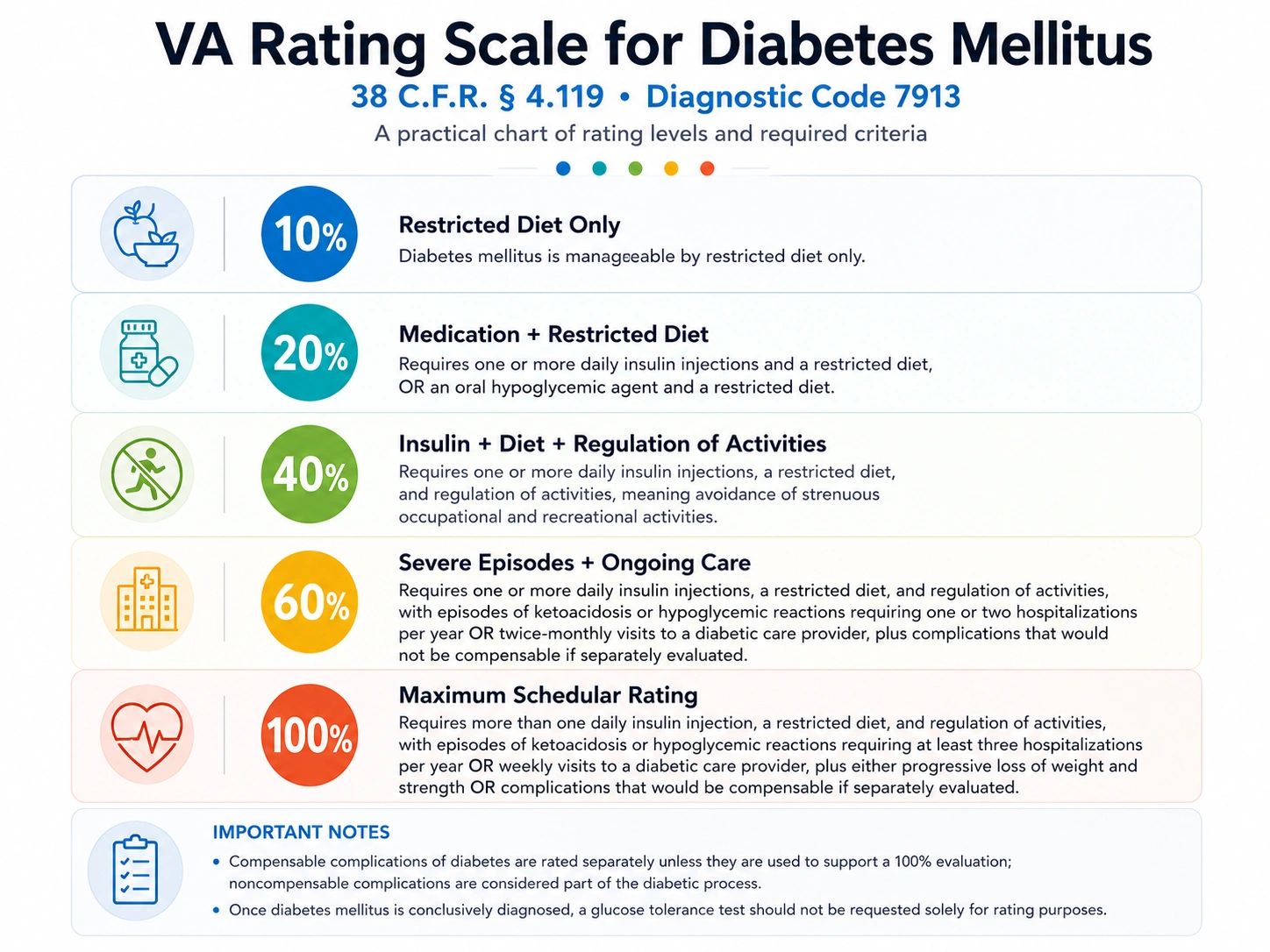
The VA rates Type 2 Diabetes Mellitus under Diagnostic Code 7913.
The rating depends largely on how the diabetes is managed and how severe the condition is. Common rating levels include:
- 10 percent: Diabetes managed by restricted diet only.
- 20 percent: Diabetes requiring insulin and restricted diet, or an oral hypoglycemic agent and restricted diet.
- 40 percent: Diabetes requiring insulin, restricted diet, and regulation of activities.
- 60 percent: Diabetes requiring insulin, restricted diet, regulation of activities, and episodes of ketoacidosis or hypoglycemic reactions requiring hospitalizations or frequent visits to a diabetic care provider, plus complications that would not be compensable if separately evaluated.
- 100 percent: Diabetes requiring more than one daily injection of insulin, restricted diet, regulation of activities, and more severe episodes of ketoacidosis or hypoglycemic reactions requiring frequent hospitalizations or very frequent diabetic care, plus progressive loss of weight and strength or complications that would be compensable if separately evaluated.
The phrase “regulation of activities” has a specific meaning in VA claims. It generally refers to a medical need to avoid strenuous occupational or recreational activities because of diabetes. A veteran should not assume this requirement is met simply because they personally avoid activity or feel fatigued.
Veteran’s Pearl: For diabetes ratings, “regulation of activities” usually needs to be medically directed. If a doctor has told the veteran to avoid strenuous activity because of diabetes, that should be clearly documented in the medical records.
Common Diabetes Complications Veterans Should Know About
Type 2 Diabetes can affect many parts of the body. Some complications may be separately rated by the VA if they are caused by diabetes and meet the criteria for a compensable rating.
Conditions that may be secondary to diabetes include:
- Diabetic peripheral neuropathy, including numbness, tingling, burning, or pain in the hands or feet.
- Diabetic retinopathy or other eye complications.
- Chronic kidney disease.
- Erectile dysfunction.
- Peripheral artery disease.
- Skin ulcers, recurrent infections, or slow-healing wounds.
- Depression or anxiety related to chronic illness and functional impairment.
- Cardiovascular complications.
If a veteran is service connected for diabetes, it is important to consider whether diabetes has caused additional complications. These conditions may affect the veteran’s combined rating and overall disability picture. Nexus letters can be used to claim conditions secondary to diabetes.
Other Conditions That May Be Secondary to Obstructive Sleep Apnea
Obstructive sleep apnea may be associated with several other medical and mental health conditions. Depending on the facts of the case, veterans may explore whether OSA caused or aggravated conditions such as:
- Hypertension.
- Atrial fibrillation.
- Coronary artery disease or other heart disease.
- Depression.
- Anxiety.
- Insomnia.
- Gastroesophageal reflux disease, also known as GERD.
- Erectile dysfunction.
- Type 2 Diabetes Mellitus.
Not every veteran with OSA will qualify for secondary service connection for these conditions. The evidence must be specific to the individual veteran. A strong nexus letter should explain the veteran’s medical history, risk factors, timing of diagnoses, severity of OSA, treatment history, and the medical reasoning connecting the conditions.
Veteran’s Pearl: VA often denies claims when the medical opinion is too generic. A strong opinion should not sound like it was copied from a textbook. It should explain why the connection makes sense for that specific veteran.
What Makes a Strong Diabetes Nexus Letter?
A strong diabetes nexus letter should do more than state a conclusion. It should provide a clear, evidence-based explanation that a layperson can understand and that addresses the medical issues VA is likely to consider.
A strong nexus letter for Type 2 Diabetes secondary to OSA should generally include:
- A review of the veteran’s relevant medical history.
- Confirmation of the veteran’s service-connected obstructive sleep apnea.
- Confirmation of the Type 2 Diabetes diagnosis.
- Discussion of the timing of symptoms and diagnoses.
- Explanation of whether OSA caused or aggravated the diabetes.
- Discussion of medical mechanisms such as intermittent hypoxia, sleep fragmentation, insulin resistance, inflammation, sympathetic activation, and metabolic dysfunction.
- Consideration of other risk factors, such as weight, age, family history, medications, and lifestyle.
- A clear medical opinion using the VA’s “at least as likely as not” standard when supported by the evidence.
- A rationale that explains why the conclusion was reached.
Veteran’s Pearl: The rationale is often the most important part of a nexus letter. VA does not have to accept a medical opinion just because it comes from a clinician. The opinion must explain the reasoning behind the conclusion.
What If VA Denied the Claim and Blamed Obesity?
Many veterans are denied because VA states that diabetes is due to obesity rather than sleep apnea. This is a common issue.
However, obesity may not be the end of the analysis. The more complete medical question may include whether the veteran’s service-connected conditions contributed to weight gain, reduced activity, poor sleep, metabolic dysfunction, or worsening insulin resistance.
For example, a veteran with severe OSA may experience chronic fatigue, daytime sleepiness, reduced ability to exercise, hormonal disruption, and difficulty losing weight. Those effects may contribute to obesity or worsen diabetes risk.
A rebuttal letter can address this issue by explaining why obesity does not necessarily rule out a secondary connection. In some cases, obesity may be part of the pathway between the service-connected condition and diabetes.
Veteran’s Pearl: When VA identifies obesity as a risk factor, the response should not simply deny that weight matters. A stronger approach is to explain the full chain of causation and whether service-connected conditions contributed to the metabolic picture.
Related Article: Obesity as an Intermediate Step
Why a Lay-Friendly Explanation Matters
Veterans often assume that the more complicated a nexus letter sounds, the stronger it is. That is not always true.
A strong medical opinion should be medically accurate, but it should also be readable. If the explanation is too vague, too technical, or too difficult to follow, the key points may be missed.
The goal is to explain complex medical science in a way that is clear, logical, and specific to the veteran.
For example, instead of only saying “OSA contributes to insulin resistance through intermittent hypoxia and neuroendocrine dysregulation,” a better explanation would also explain what that means: sleep apnea causes repeated oxygen drops and stress responses during sleep, which can make the body less responsive to insulin and make blood sugar harder to control.
Why Dr. Allen Is Qualified to Write Diabetes Nexus Letters
Dr. Jessica Allen is a psychiatrist and medical doctor. Her medical training includes physiology, pharmacology, pathophysiology, and the systemic effects of chronic medical and psychiatric conditions.
Although psychiatry focuses on mental health, psychiatrists are physicians who complete medical school and receive training in how the body’s systems interact. This is especially important in VA disability claims because many veterans have overlapping physical and mental health conditions, including obstructive sleep apnea, depression, anxiety, chronic pain, weight gain, diabetes, insomnia, and fatigue.
Dr. Allen’s approach focuses on explaining the medical connection in a clear, evidence-based, and veteran-specific manner. For diabetes secondary to OSA, that means addressing not only the diagnosis, but also the biological mechanisms that may connect sleep apnea to diabetes.
A well-supported nexus letter may help clarify the medical relationship between a veteran’s service-connected obstructive sleep apnea and Type 2 Diabetes Mellitus.
Final Thoughts
Type 2 Diabetes secondary to obstructive sleep apnea can be a complex VA disability claim. The connection is not always obvious to veterans, and VA may deny the claim if the evidence does not clearly explain the medical relationship.
However, OSA can affect much more than sleep. Through oxygen drops, fragmented sleep, stress hormone activation, inflammation, weight-related pathways, and insulin resistance, obstructive sleep apnea may contribute to the development or worsening of Type 2 Diabetes in some veterans.
If you are a veteran with service-connected obstructive sleep apnea and Type 2 Diabetes Mellitus, a detailed medical nexus letter may help support your claim by explaining the connection in a way that is medically sound and understandable.
Schedule a Free Phone Consultation: https://intakeq.com/booking/ioezdg
____________________________________________________________________
About the Author
This article was authored by Dr. Jessica Allen, M.D., a physician and psychiatrist with experience evaluating veterans and writing medical nexus letters for VA disability claims. Dr. Allen’s medical training includes psychiatry, physiology, pharmacology, pathophysiology, and the relationship between chronic medical conditions, sleep disorders, mental health conditions, and functional impairment.
Through Brightview Psychiatry Solutions, Dr. Allen prepares evidence-based nexus letters that explain complex medical relationships in clear, medically grounded language. Her work often involves reviewing veterans’ medical histories, service-connected conditions, VA rating decisions, medical literature, and the biological mechanisms that may support secondary service connection.
This blog is intended for educational purposes only. It does not create a physician-patient relationship, does not provide individualized medical advice, and does not guarantee any specific VA claim outcome. Every veteran’s case is unique, and the strength of a claim depends on the medical evidence, service-connected disabilities, treatment history, risk factors, and the facts of the individual case.