
Depression Nexus Letters from a Psychiatrist

Depression nexus letter from a psychiatrist: why the author matters
Author: Jessica R. Allen, Psychiatrist and Former C&P Examiner
Reviewed: July 2026
To discuss your case with Dr. Allen, please call our office at (919) 849-817 or schedule a free phone consultation.
Many veterans treat a nexus letter as a commodity—a form any doctor can sign. It isn’t. When the VA evaluates a claim, it does not simply count medical opinions; it weighs them. And two of the things it weighs are the strength of the reasoning and the qualifications of the person who wrote it. For a depression claim, that makes the author of your nexus letter matter more than most veterans realize.
The short version: The VA gives a nexus letter more weight when it is well-reasoned and written by someone with relevant expertise. Because depression is a psychiatric diagnosis, a well-reasoned opinion from a psychiatrist carries particular weight—and one from a former C&P examiner speaks the VA’s language.
Does it matter who writes your nexus letter?
Yes. The governing case is Nieves-Rodriguez v. Peake, in which the U.S. Court of Appeals for Veterans Claims laid out how medical opinions are weighed. The VA cannot simply prefer its own examiner’s opinion because the VA ordered it. Instead, the probative value of any opinion—private or VA—turns on whether it rests on accurate facts, applies sound medical principles, and, above all, explains its reasoning. As the Court put it, most of a medical opinion’s value comes from its reasoning. A bare conclusion—“this condition is at least as likely as not related to service,” with nothing behind it—can be given little or no weight.
That framework is drawn from how courts assess expert testimony, and it has a direct consequence: the person offering the opinion, and the depth of their reasoning, are part of what the VA is required to consider. Who writes your letter is not a formality.
Who can write a nexus letter for depression?
Any licensed physician—and in many cases other qualified providers such as psychologists or nurse practitioners—can write a nexus letter. Your primary care doctor can. A therapist can contribute records and observations. But “can write one” is not the same as “writes one the VA will find most persuasive.” The letter still has to clear the bar above—sound reasoning, accurate facts, the right standard of proof—and the author’s expertise is one of the factors that affects how much weight it carries.
Why a psychiatrist’s opinion carries particular weight for depression
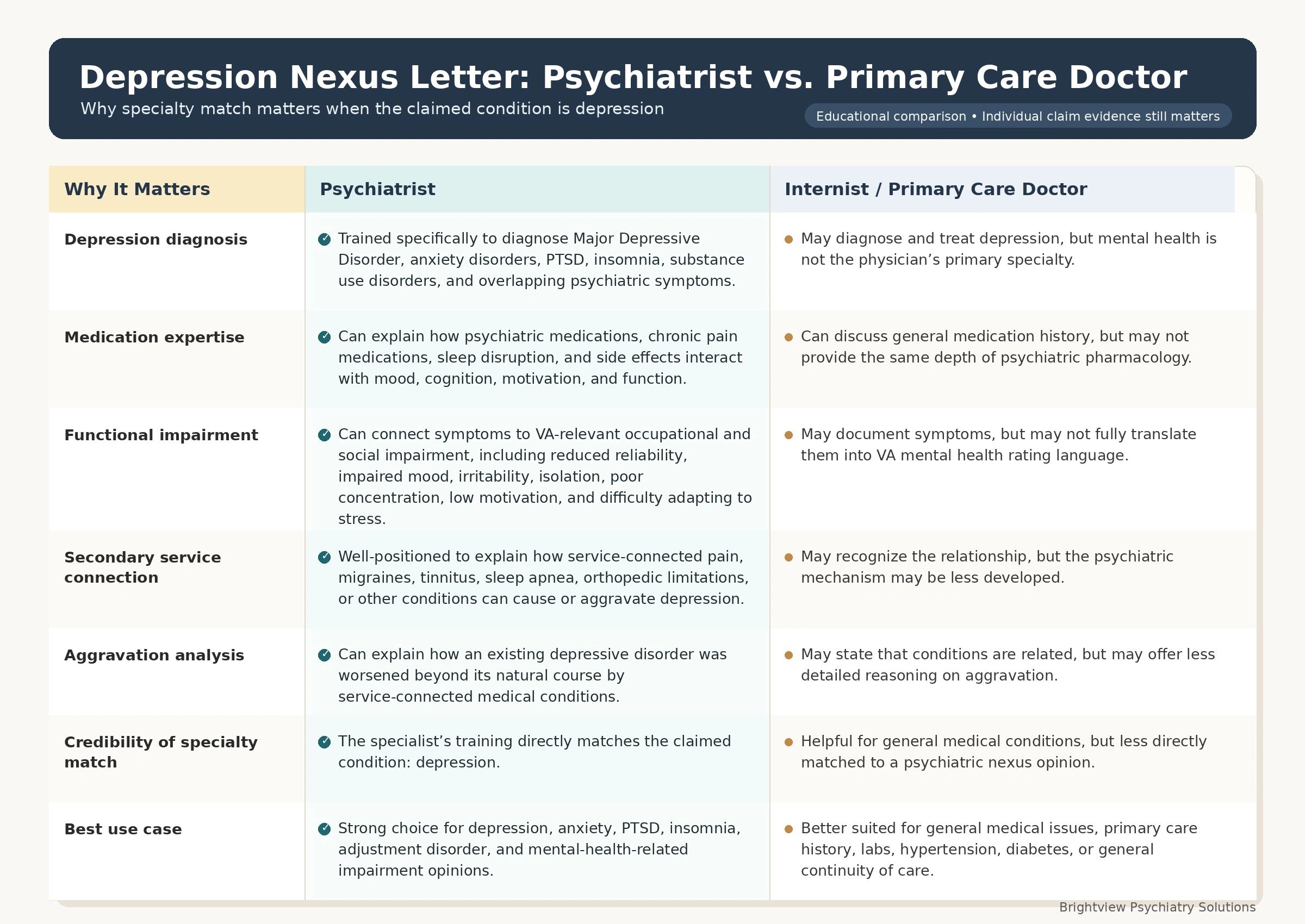
Depression is a psychiatric diagnosis. Psychiatry is the medical specialty devoted to diagnosing and treating it. When an opinion about depression comes from a psychiatrist, it is a specialist speaking within their own field—and an opinion from a specialist in the relevant area typically carries more probative weight than the same opinion from a generalist. A psychiatrist nexus letter for depression is, in the VA’s weighing process, a specialist’s assessment rather than a general one.
This deserves an honest caveat. It does not mean a letter from a non-specialist is worthless—a well-reasoned opinion from your treating primary care physician can absolutely help. It means a specialist’s well-reasoned opinion is stronger and less vulnerable to being outweighed by a contrary opinion. Expertise is a thumb on the scale, not the whole scale.
The overlooked advantage: a former C&P examiner
There is a second qualification that matters just as much and is far rarer: experience as a VA Compensation & Pension (C&P) examiner. The C&P examiner is the person who performs the exam the VA relies on. A doctor who has worked that role has seen, from the inside, what a rater needs, how a nexus opinion must be reasoned to hold up, and where opinions fall apart. A letter written with that knowledge is built to be weighed favorably—because its author has done the weighing.
Want a depression nexus letter written by a psychiatrist and former C&P examiner?
So who is the best doctor for a depression nexus letter?
There is no single “best” doctor for every case—but there are clear criteria for the ideal author. When choosing who writes your depression nexus letter, look for someone who offers:
- Relevant specialty. For depression, that means a psychiatrist (or psychologist)—the field that diagnoses and treats the condition.
- Sound, thorough reasoning. The letter should explain the mechanism, cite your records and the medical literature, and use the “at least as likely as not” standard—not a one-line conclusion.
- Familiarity with VA standards. Someone who understands how the VA weighs opinions—ideally a former C&P examiner—can write to that standard.
- Honesty. A provider who will tell you when the evidence does not support a favorable opinion is protecting you from a weak claim, not losing a sale.
Dr. Allen was chosen for this practice precisely because she meets these criteria: a psychiatrist evaluating a psychiatric condition, and a former VA C&P examiner who knows the standard from the inside.
To discuss your case with Dr. Allen, please call our office at (919) 849-817 or schedule a free phone consultation.
What still makes or breaks the letter—even from a psychiatrist
Credentials open the door; reasoning wins the room. Even the ideal author has to produce an opinion that is factually accurate, thoroughly reasoned, and stated at the correct standard of proof. A psychiatrist’s letter that is conclusory or built on an inaccurate premise can still be discounted. And no letter—however well-credentialed the author—can guarantee an outcome; the VA weighs the whole record and makes the decision. The author matters because expertise is one of the factors on the scale. Reasoning is the heaviest weight on it.
Frequently asked questions
Does a nexus letter have to be from a psychiatrist?
No. Any licensed physician, and often other qualified providers, can write one. But for depression—a psychiatric diagnosis—a well-reasoned opinion from a psychiatrist typically carries more probative weight, because it comes from a specialist in the relevant field.
Can my primary care doctor write my depression nexus letter?
Yes, and a thorough, well-reasoned letter from a treating physician can genuinely help. Just know that a specialist’s opinion is generally harder to outweigh, so weigh that against the value of your doctor’s direct familiarity with your history.
Is a nexus letter from a specialist better?
In the VA’s weighing process, an opinion from a specialist in the relevant field typically carries more probative value than the same opinion from a generalist—provided it is well-reasoned. Specialty strengthens a good letter; it does not rescue a conclusory one.
Is a therapist’s nexus letter enough for depression?
Sometimes it can help, but it may not be the strongest option. A therapist can provide valuable evidence about symptoms, treatment history, and functional impairment. However, for a formal depression nexus opinion, the VA may give more weight to a well-reasoned opinion from an M.D., D.O., Ph.D., or Psy.D. because those providers generally have more extensive diagnostic and etiological training. Ideally, a therapist’s records can support the claim while a psychiatrist or psychologist provides the formal nexus opinion.
Does a psychiatrist nexus letter guarantee my depression claim is approved?
No. No author and no letter can promise an outcome. The VA weighs all the evidence and decides. A well-reasoned letter from the right specialist strengthens your position; it does not guarantee it.
Sources and Authority
How the VA weighs medical opinions is governed by decisions of the U.S. Court of Appeals for Veterans Claims, including:
- Nieves-Rodriguez v. Peake, 22 Vet. App. 295 (2008) — the probative value of a medical opinion turns on its factual accuracy, sound methodology, and, above all, its reasoning.
- Stefl v. Nicholson, 21 Vet. App. 120 (2007) — a medical opinion must contain a reasoned explanation connecting the conclusion to the supporting data.
Request a Consultation
Talk to a psychiatrist and former C&P examiner
If you need a depression nexus letter, Dr. Allen can review your records and give you an honest assessment of whether an independent medical opinion would support your claim.