
How to Write a Strong Personal Statement for Your VA Claim

Author: Jessica Allen, M.D., physician and former C&P examiner
To schedule a call with Dr. Allen to discuss your VA disability claim, your nexus letter needs, or to review your personal statement, please book a free phone consultation here.
For this blog post we will use the example: Sleep Apnea Secondary to Service-Connected Sinusitis.
When filing a VA disability claim, your personal statement is one of your most powerful tools. This is your chance to explain, in your own words, how your medical condition is linked to your military service and how it impacts your daily life.
You’ll submit this information using VA Form 21-4138: Statement in Support of Claim. In this post, we’ll guide you through how to write an effective statement—especially when you're claiming sleep apnea (OSA) as secondary to a service-connected sinusitis condition.
What Is VA Form 21-4138?
VA Form 21-4138, Statement in Support of Claim, is used to provide personal, narrative evidence to support your VA claim. You can use it to:
✔️Share details the VA might not find in medical records ✔️Explain symptoms you experienced during service ✔️Describe why you didn’t seek certain treatments at the time ✔️Establish links between conditions for secondary claims
You can download the form directly from the VA’s website, here.
Writing an Effective Statement: Key Tips
To make your personal statement impactful, follow these guidelines:
- Be specific and honest. Describe what you experienced in detail.
- Use a timeline. Indicate when symptoms started, even if you’re estimating.
- Explain knowledge gaps. It’s okay if you didn’t recognize your condition at the time.
- Show the connection between your service-connected condition and your secondary one.
- Describe cause-and-effect. Detail how flare-ups in one condition make the other worse.
Example Scenario: Sleep Apnea Secondary to Service-Connected Sinusitis
Let’s say you’re a veteran with a VA-recognized (service-connected) diagnosis of chronic sinusitis. After discharge, you begin experiencing symptoms of obstructive sleep apnea—but you didn’t pursue a sleep study while on active duty because you weren’t familiar with the condition.
Now, you’re filing a secondary claim for sleep apnea, based on how it was caused or worsened by your sinusitis. Below is an example of how your VA Form 21-4138 personal statement might look.
Sample Personal Statement (VA Form 21-4138)
Veteran’s Full Name: John R. Smith SSN (Last Four): 1234 Date: [Today’s Date] Statement in Support of Claim: Sleep Apnea Secondary to Service-Connected Sinusitis I am submitting this statement in support of my VA disability claim for obstructive sleep apnea, which I am claiming as secondary to my already service-connected sinusitis condition. I served on active duty from 2002 to 2010. During that time, I had repeated bouts of sinus infections, nasal congestion, and post-nasal drip. These symptoms were frequent and often led to headaches and daytime fatigue. I received treatment for sinusitis several times while on active duty, and the VA has since granted service connection for this condition. At the time, I wasn’t aware of obstructive sleep apnea or its symptoms. Although I often felt unrested and had issues with sleep, I assumed this was due to my sinus issues or stress. I never requested a sleep study during my service because I didn’t understand sleep apnea was a medical issue. Since leaving the military, my symptoms continued and worsened. My spouse began noticing that I would snore loudly, sometimes stop breathing in my sleep, and often gasp for air. These symptoms were especially severe during sinus infections or when my congestion was worse. In 2018, I underwent a sleep study and was diagnosed with obstructive sleep apnea. I now use a CPAP machine, but I’ve noticed that during sinusitis flare-ups, my CPAP is less effective and my OSA symptoms become more intense. There is a clear pattern: whenever my sinusitis worsens—due to infection, congestion, or post-nasal drip—my sleep quality significantly deteriorates. It is my sincere belief that my obstructive sleep apnea developed as a result of the chronic sinus issues I experienced during active duty. Since sinusitis is already recognized as service-connected, I am respectfully requesting that my claim for obstructive sleep apnea be considered as secondary to this established condition. Thank you for reviewing my statement and considering my request. Sincerely, John R. Smith
Why This Statement Works
This sample checks all the boxes:
✔️ Identifies the primary (sinusitis) and secondary (OSA) conditions
✔️ Explains in-service symptoms clearly
✔️ Provides a logical timeline and reason for delayed diagnosis ✔️ Describes how the two conditions interact in everyday life
Final Thoughts
Your personal statement tells your story—what you experienced, how your condition developed, and how it continues to affect you. Especially for secondary claims like sleep apnea caused or worsened by sinusitis, this statement is vital for connecting the dots.
Usually, a well-written personal statement is not enough. A nexus letter plays a separate role in getting conditions service-connected. A well-written personal statement, when paired with a well-reasoned nexus letter authored by a qualified physician who has reviewed your medical records and conducted a thorough review of the relevant medical literature, can significantly strengthen your VA disability claim. This powerful combination brings both your voice and medical credibility to the case, increasing the likelihood of a successful outcome.
Need a nexus letter or understanding how to build a strong claim? Contact us at (919) 849-8617 —we’re here to help veterans present their truth with clarity, evidence, and confidence.
Schedule A Free Phone Consultation: https://intakeq.com/booking/ioezdg
Relevant Webpages
Sleep Apnea Secondary to Sinusitis Nexus Letter
About Dr. Jessica Allen
Jessica Allen, M.D., is a physician and former VA Compensation & Pension (C&P) examiner who writes medical nexus letters for veterans pursuing VA disability claims. Her experience reviewing VA claims from both the clinical and examination perspective allows her to understand what the VA is looking for, how medical evidence should be explained, and why a clear, well-supported nexus opinion matters.
Dr. Allen’s nexus letters are based on a careful review of the veteran’s records, relevant medical history, lay statements when available, and current medical literature. Her goal is to help veterans present their claims with medical clarity, evidence-based reasoning, and a professional opinion that addresses the specific question of service connection.
To schedule a call with Dr. Allen to discuss your VA disability claim, nexus letter needs, or personal statement, please book a free phone consultation here: https://intakeq.com/booking/ioezdg
Frequently Asked Questions About VA Personal Statements and Nexus Letters
Can a personal statement help my VA disability claim?
Yes. A personal statement can be valuable because it allows you to explain your symptoms, timeline, functional limitations, and lived experience in your own words. Medical records do not always capture how a condition affects your daily life, work, sleep, mood, relationships, or ability to function. A strong personal statement can help fill in those gaps and provide context for the VA.
However, a personal statement is not the same as a medical nexus opinion. If your claim involves medical causation, secondary service connection, aggravation, or a prior denial based on lack of nexus evidence, you may also need a well-reasoned medical opinion from a qualified professional.
What is the difference between a personal statement and a nexus letter?
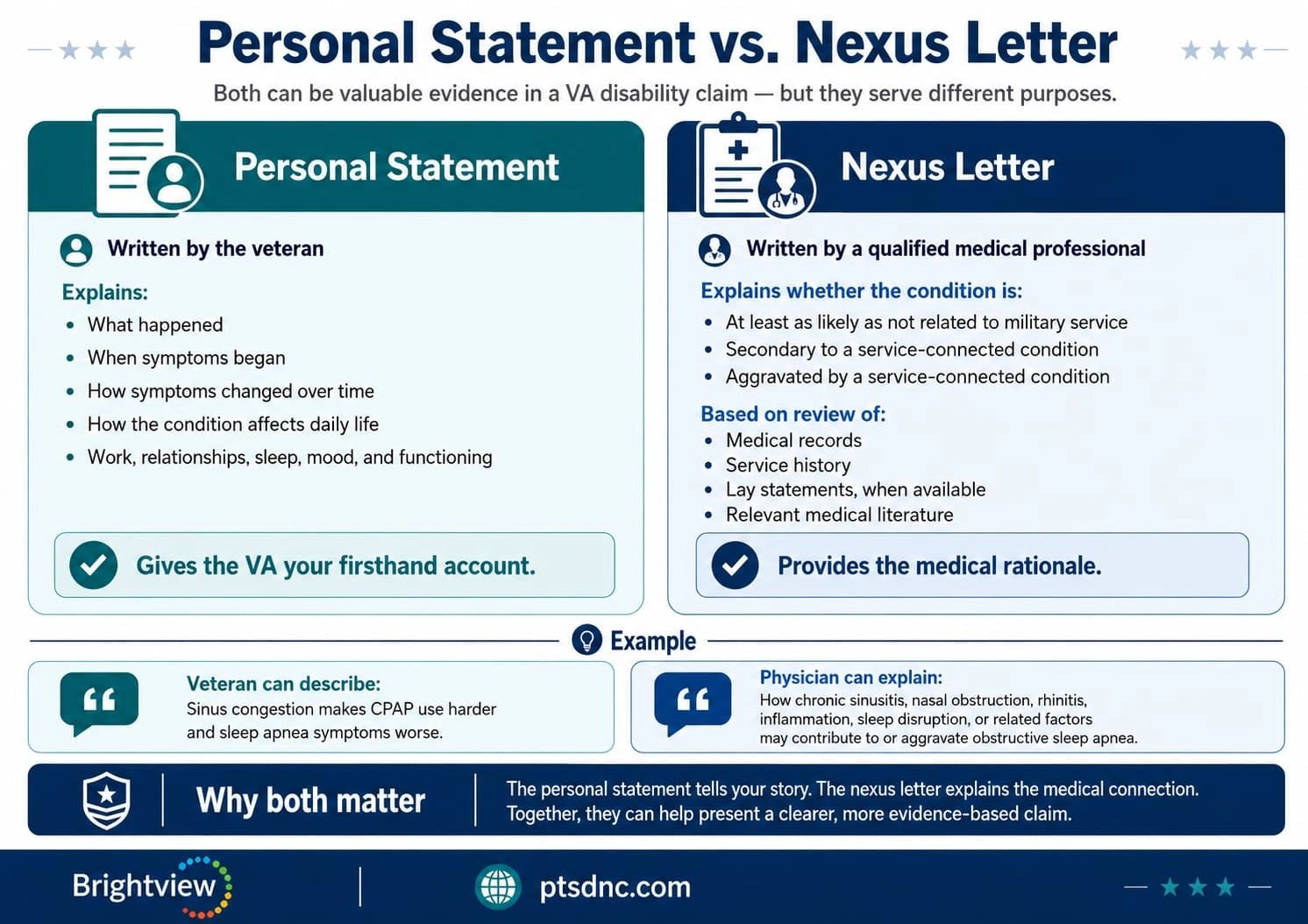
A personal statement is written by the veteran. It explains what happened, when symptoms began, how symptoms have changed over time, and how the condition affects daily life.
A nexus letter is written by a qualified medical professional. It explains whether a diagnosed condition is at least as likely as not related to military service, secondary to a service-connected condition, or aggravated by a service-connected condition. A nexus letter should be based on a review of the veteran’s records, medical history, lay statements when available, and relevant medical literature.
Both types of evidence can be helpful. The personal statement tells your story. The nexus letter provides the medical rationale.
Do I need a nexus letter if I already wrote a personal statement?
Possibly. A personal statement can describe your symptoms and how your condition affects you, but it usually cannot replace a medical nexus opinion when the VA needs a medical explanation.
You may need a nexus letter if you are filing a secondary claim, if your condition was diagnosed after service, if the VA previously denied your claim due to lack of a medical link, or if the VA attributed your condition to another cause such as age, obesity, smoking, genetics, or lifestyle factors.
When is a nexus letter especially helpful?
A nexus letter may be helpful when the claim involves a medical question that the VA needs answered. This often includes claims involving:
• Sleep apnea secondary to PTSD, sinusitis, rhinitis, asthma, or weight gain related to service-connected conditions
• Depression or anxiety secondary to chronic pain, tinnitus, hearing loss, migraines, or other medical conditions
• Migraines secondary to tinnitus, PTSD, sleep disturbance, or medication effects
• GERD, hypertension, urinary problems, or other conditions claimed as secondary to a service-connected disability
• TDIU claims where service-connected symptoms interfere with substantially gainful employment
• Claims that were previously denied because the VA found no nexus or no medical relationship
Each case depends on the veteran’s records, diagnoses, service history, and specific medical facts.
What should I include in my VA personal statement?
A strong VA personal statement should usually include:
• The condition you are claiming
• When symptoms began
• What happened during service, if relevant
• How symptoms have changed over time
• How often symptoms occur
• How severe the symptoms are
• How long symptoms last
• How the condition affects work, relationships, sleep, mood, concentration, and daily functioning
• Any treatment, medications, medical devices, or therapy you have used
• Observations from your spouse, family members, coworkers, or friends
• Why you believe the condition is related to service or to an already service-connected condition
The statement should be honest, specific, and consistent with the available medical evidence.
What should I avoid saying in a VA personal statement?
Avoid vague statements such as “my condition is bad” without explaining how it affects you. Also avoid exaggerating symptoms, making statements that conflict with your medical records, or trying to provide medical conclusions without supporting evidence.
For example, a veteran can explain, “My sinus congestion makes it harder to tolerate my CPAP and my sleep apnea symptoms feel worse during sinus flare-ups.” However, the medical explanation of how sinusitis, nasal obstruction, rhinitis, inflammation, or sleep disruption may contribute to or aggravate obstructive sleep apnea is usually better addressed in a nexus letter by a qualified medical professional.
Can my spouse or family member write a statement too?
Yes. Statements from a spouse, family member, friend, coworker, or fellow service member can sometimes help support a VA claim. These are often called lay statements, witness statements, or buddy statements.
A spouse may be able to describe symptoms the veteran does not fully notice, such as loud snoring, pauses in breathing, gasping during sleep, mood changes, irritability, panic attacks, memory problems, social withdrawal, or functional decline over time.
What if the VA already denied my claim?
If the VA denied your claim, it is important to review the reason for the denial. Many claims are denied because the VA finds no medical nexus, no diagnosis, no evidence of chronicity, or no link between the claimed condition and military service or a service-connected disability.
A personal statement may help clarify your history and symptoms, but if the denial was based on lack of medical nexus evidence, a personal statement alone may not be enough. In that situation, a well-supported nexus letter may help address the specific reason the VA denied the claim.
Can Dr. Allen review my personal statement?
Yes. Dr. Jessica Allen can review your personal statement as part of evaluating whether your claim may benefit from additional medical evidence, including a nexus letter. A personal statement can help explain your lived experience, while a nexus letter can address the medical reasoning behind service connection, secondary service connection, or aggravation. Schedule a free phone consultation →
Does Dr. Allen write nexus letters for sleep apnea claims?
Yes. Dr. Jessica Allen writes medical nexus letters for veterans pursuing VA disability claims, including claims involving obstructive sleep apnea when supported by the veteran’s records and medical history. Sleep apnea claims often involve complex medical questions, especially when claimed as secondary to PTSD, sinusitis, rhinitis, asthma, medication effects, weight gain related to service-connected conditions, or other service-connected disabilities.
How do I schedule a free phone consultation?
You can schedule a free phone consultation with Dr. Jessica Allen to discuss your VA disability claim, nexus letter needs, or personal statement review here:
https://intakeq.com/booking/ioezdg
During the consultation, you can discuss the type of claim you are filing, whether you have already received a VA denial, what conditions are service-connected, and whether a nexus letter may be appropriate based on your situation.