
PTSD From Witnessing a Traumatic Event In Service
PTSD From Witnessing a Traumatic Event During Military Service: The Parris Island Lightning Strike and VA Claims
Authored by Dr. Jessica Allen, Psychiatrist and PTSD Expert
To schedule a free phone consultation with Dr. Allen use this link.
Veterans can develop PTSD after witnessing a traumatic event during military service, even if the event did not occur in combat. A service-related traumatic event may include witnessing a death, serious injury, training accident, aircraft crash, lightning strike, suicide, assault, explosion, vehicle accident, or another life-threatening incident involving fellow service members. For VA disability purposes, the key issue is whether the veteran experienced, witnessed, or was confronted with an event involving actual or threatened death, serious injury, or sexual violence, and whether that event contributed to current PTSD symptoms.
Non-Combat PTSD Examples: PTSD From Witnessing a Traumatic Event During Military Service
When many people think about posttraumatic stress disorder, or PTSD, they often think of combat. Combat trauma is one well-known cause of PTSD, but it is not the only one. Veterans may also develop PTSD after witnessing a traumatic event during military service, including the death or serious injury of another service member.
This article is part of our non-combat PTSD examples series, which examines real-world military events that may help veterans understand how traumatic experiences outside of combat can still support a VA mental health claim when the evidence is properly developed.
For veterans, traumatic events may occur during combat, deployments, recruit training, field exercises, aircraft incidents, vehicle rollovers, drownings, fires, explosions, medical emergencies, assaults, suicides, training accidents, or other catastrophic events. A veteran does not necessarily have to be physically injured for the event to have a lasting psychological impact.
One example from Marine Corps recruit training history is the August 1995 lightning strike at Marine Corps Recruit Depot Parris Island.
The 1995 Parris Island Lightning Strike
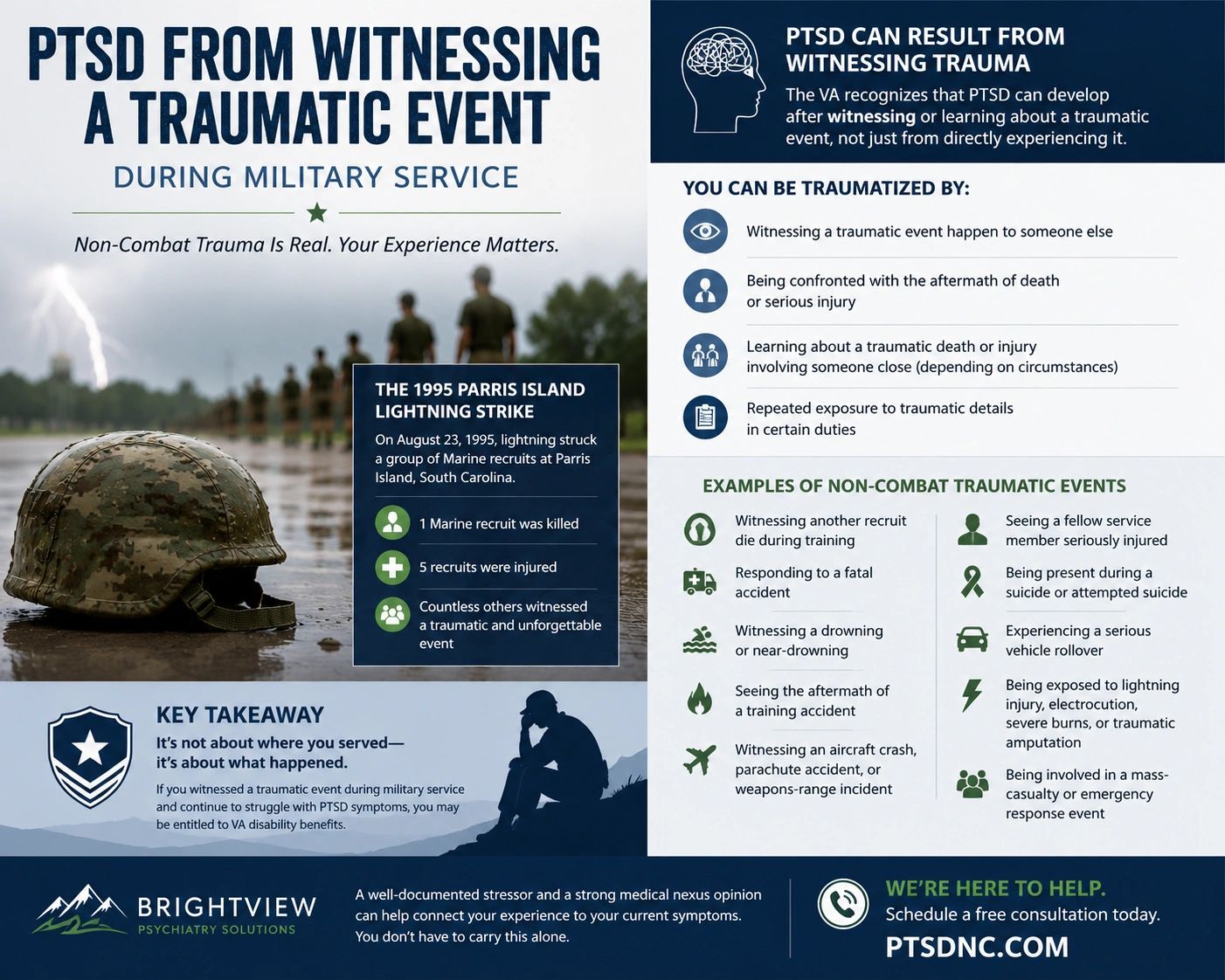
On August 23, 1995, news outlets reported that a group of Marine recruits at Parris Island, South Carolina, were struck by lightning during recruit training. UPI reported that one Marine recruit was killed and five were injured at the military training facility.
The Associated Press reported that the recruits were on a rifle range when lightning struck, and that they were members of the 1st Recruit Training Battalion. A public memorial listing for Colby M. Cutler also identifies his date of death as August 23, 1995, at Parris Island, with the cause of death listed as a lightning strike.
For those who were present, nearby, involved in the immediate aftermath, or exposed to the scene in some other direct way, an event like this may be remembered vividly. Some veterans may recall the weather, the sound of the strike, the confusion, the medical response, the fear, or the sight of fellow recruits injured or dying. Others may have attempted to help, been ordered to move away, or learned shortly afterward that someone in their training environment had died.
Not every person exposed to a traumatic event develops PTSD. However, for some veterans, witnessing a sudden death or serious injury during service can become a lasting psychological injury.
Can PTSD Be Caused by Witnessing a Death or Serious Injury?
Yes. PTSD can develop after exposure to actual or threatened death, serious injury, or sexual violence. The VA’s National Center for PTSD explains that PTSD diagnostic criteria require exposure to a traumatic or stressful event.
This exposure can occur in more than one way. A veteran may be traumatized by:
- Directly experiencing a traumatic event
- Witnessing a traumatic event happen to someone else
- Being confronted with the aftermath of death or serious injury
- Learning about a traumatic death or injury involving someone close, depending on the circumstances
- Repeated exposure to traumatic details in certain duties
The VA’s own PTSD Checklist with Criterion A asks whether the event involved actual or threatened death, serious injury, or sexual violence, and includes options for direct experience, witnessing the event, learning about it happening to a close family member or friend, or repeated occupational exposure to traumatic details.
Non-Combat PTSD Is Real
Some veterans feel that if they did not serve in combat they are not entitled to file PTSD claims, and some feel guilty about being traumatized by non-combat stressors. PTSD does not discriminate and no veteran should ever have their psychological trauma be invalidated. A veteran does not need to have served in combat to develop PTSD. Many veterans experience trauma during recruit training, stateside service, overseas assignments, humanitarian missions, military law enforcement duties, medical duties, aviation duties, or emergency response duties.
Examples of non-combat traumatic events may include:
- Witnessing another recruit die during training
- Seeing a fellow service member severely injured
- Responding to a fatal accident
- Being present during a suicide or attempted suicide
- Experiencing a serious vehicle rollover
- Witnessing a drowning or near-drowning
- Seeing the aftermath of a training accident
- Being exposed to severe burns, electrocution, lightning injury, or traumatic amputation
- Being involved in a mass-casualty or emergency response event
- Witnessing an aircraft crash, parachute accident, or weapons-range incident
The key issue for a VA claim is not whether the event happened in combat. The key issue is whether the veteran has a current mental health diagnosis, whether the in-service stressor can be supported, and whether a qualified medical professional can explain the relationship between the stressor and the veteran’s current symptoms.
Did you witness a trauma on active duty? Discuss your case with Dr. Allen by scheduling a free phone consultation at this link.
Why the Parris Island Lightning Strike Could Be Psychologically Traumatic
Witnessing death or serious injury during military service can affect the brain and nervous system in lasting ways. A veteran may feel helpless, horrified, guilty, unsafe, or unable to process what happened. Some veterans blame themselves even when they had no control over the event. Others replay the incident repeatedly, wondering whether something could have been done differently.
Veterans who were present at Parris Island during the August 1995 lightning strike may have experienced the event from different perspectives. Some may have been in the same training battalion. Some may have been on or near the rifle range. Some may have heard the strike, seen the aftermath, helped move injured recruits, or learned details shortly afterward while still in a high-stress recruit-training environment.
For some veterans, the memory of that event may have stayed with them long after leaving Parris Island. A veteran affected by this type of event may report recurrent memories of the lightning strike, distress during thunderstorms, avoidance of outdoor activities during bad weather, guilt about surviving or not being able to help, nightmares involving training, storms, death, or helplessness, hypervigilance during sudden weather changes, emotional numbing when discussing recruit training, anxiety when hearing thunder or loud explosive sounds, irritability, sleep disruption, or difficulty explaining why the event still feels present decades later.
These symptoms should be evaluated carefully by a qualified mental health professional. The fact that an event occurred decades ago does not mean it cannot still be clinically significant. If you are interested in undergoing a psychiatric evaluation with Dr. Allen to determine if you might have PTSD, book a free phone consultation at this link.
VA PTSD Claims Based on Witnessed Trauma
For VA disability purposes, PTSD claims generally require three major components:
- A current diagnosis of PTSD or another mental health condition
- Evidence supporting that an in-service stressor occurred
- Medical evidence linking the current mental health condition to the in-service stressor
VA’s PTSD compensation page states that veterans may be eligible for disability compensation when they have posttraumatic stress from a traumatic event experienced during service.
For PTSD claims, VA also has specific rules about stressor evidence. Under 38 C.F.R. § 3.304(f), service connection for PTSD requires medical evidence diagnosing the condition in accordance with 38 C.F.R. § 4.125(a), a medical link between current symptoms and an in-service stressor, and credible supporting evidence that the claimed in-service stressor occurred.
A witnessed training accident, lightning strike, death, or serious injury may require documentation or corroboration, especially if the veteran was not diagnosed with PTSD during service and the stressor does not fall under a special evidentiary category such as combat, fear of hostile military or terrorist activity, prisoner-of-war status, or military sexual trauma.
Can Newspaper Articles Help Corroborate a Non-Combat PTSD Stressor?
Yes. Newspaper articles may help support a VA PTSD claim when the stressor involves a documented non-combat event, such as a training accident, recruit death, aircraft crash, drowning, fire, explosion, or natural-disaster-related incident. A news article can help establish that the event occurred, when and where it happened, whether death or serious injury occurred, and whether the event is consistent with the veteran’s account.
However, a newspaper article usually does not prove the veteran’s personal exposure by itself. The veteran may still need evidence showing that they were present, nearby, assigned to the relevant unit, involved in the response, or otherwise directly exposed to the traumatic event. For example, articles about the Parris Island lightning strike may help corroborate that the incident occurred, but service records, personal statements, buddy statements, mental health records, and a medical nexus opinion may be needed to connect that event to the veteran’s current PTSD symptoms.
This type of combined evidence can be especially important for older non-combat events, where formal incident records may be difficult to obtain or where the veteran did not seek mental health treatment during service.
What If the Veteran Was Not Physically Injured?
A veteran does not have to be physically injured to develop PTSD. Witnessing another person’s death or serious injury can be traumatic on its own.
This is important because many veterans minimize their own trauma by saying things like:
- “I wasn’t the one who died.”
- “Other people had it worse.”
- “I was not physically hurt.”
- “I should have gotten over it.”
- “It happened in training, not combat.”
- “I didn’t know I could claim PTSD for something I witnessed.”
These thoughts are common, but they do not determine whether a veteran has PTSD. The clinical question is whether the veteran was exposed to a qualifying traumatic event and developed persistent symptoms connected to that event.
Are you finally ready to explore the symptoms you've been experiencing for years? Schedule a free phone consultation at this link.
Delayed PTSD Symptoms After Military Trauma
Some veterans do not fully recognize their PTSD symptoms until years later. They may leave the military, build a career, start a family, and try to move forward. Over time, symptoms may become more noticeable because of stress, aging, retirement, medical illness, sleep problems, anniversaries of the event, or exposure to reminders.
A veteran who witnessed a traumatic event in the 1990s may still experience symptoms decades later. A credible PTSD diagnosis can be made years after the original PTSD event. Dr. Allen specializes in diagnosing PTSD.
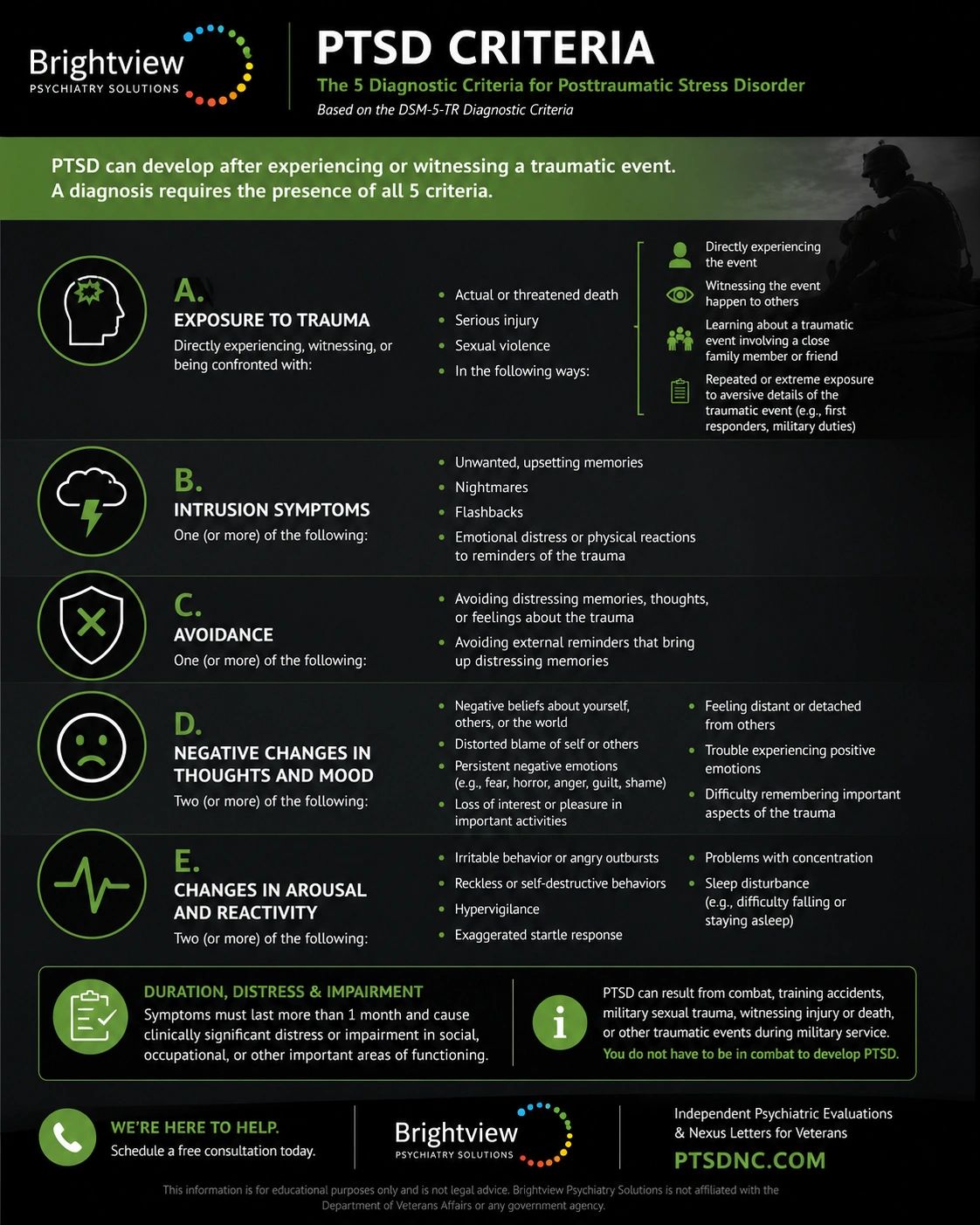
Diagnostic Criteria for PTSD:
Can a Nexus Letter Help?
A PTSD nexus letter may help when a veteran has a current diagnosis and a documented or supportable in-service traumatic event, but VA has not accepted the connection between the two.
A strong PTSD nexus letter should be individualized. It should not simply state that the veteran has PTSD. It should explain how the veteran’s symptoms, history, records, and stressor exposure support the medical opinion.
A persuasive opinion may address:
- The veteran’s specific stressor
- Whether the stressor involved actual or threatened death or serious injury
- The veteran’s exposure to the event
- Symptom onset and progression
- Current PTSD symptoms
- Functional impairment
- Alternative explanations considered
- Relevant medical and service records
- The “at least as likely as not” standard
For witnessed events such as the Parris Island lightning strike, the nexus opinion should carefully explain the veteran’s relationship to the event and the psychological impact over time.
Schedule a free phone consultation to discuss how a nexus letter might strengthen your case at this link.
Veterans Who Witnessed the Parris Island Lightning Strike
If you were at Marine Corps Recruit Depot Parris Island in August 1995 and witnessed, heard, responded to, or were otherwise exposed to the lightning strike that killed one Marine recruit and injured others, that experience may still matter.
You may have tried for years to dismiss it as “just something that happened in boot camp.” You may have avoided talking about it. You may have felt that because you were not physically injured, you had no right to be affected by it.
But witnessed trauma can be real trauma.
If you have ongoing symptoms such as nightmares, intrusive memories, storm-related anxiety, avoidance, guilt, hypervigilance, sleep problems, irritability, depression, or emotional numbness, it may be worth speaking with a qualified mental health professional.
Examples of Military Training Accidents and Lightning Strike Incidents That May Be Traumatic:
- Camp Ripley, Minnesota — July 2001: Nearly two dozen Marines or military personnel were reportedly injured when lightning struck during training at Camp Ripley. Some were hospitalized, and reports described service members being shocked during field training conditions. Deseret News report / ABC News report
- Camp Shelby, Mississippi — June 2011: A lightning strike at a military training base reportedly led to 77 Air Force Reserve cadets being transported to hospitals for evaluation, with two taken by ambulance and others transported by bus. The Dispatch report
- Fort Drum, New York — August 2012: Ten New Jersey Army National Guard soldiers were reportedly injured by lightning while training at Fort Drum. Several were evaluated and returned to duty, while others required medical care. MyNBC5/AP report
- Fort Drum, New York — August 2014: Six soldiers were reportedly hurt by lightning during a field exercise at Fort Drum. According to Army Times, four returned to duty while two remained hospitalized. Army Times report
- Fort Bragg, North Carolina — August 2015: Eighteen paratroopers from the 82nd Airborne Division were reportedly injured in a lightning strike during routine training. Army Times report
- Marine Corps Air Station New River, North Carolina — July 2017: A Marine Corps tiltrotor mechanic, Cpl. Skyler James, died after being struck by lightning while working near an MV-22 Osprey. Another Marine was also reportedly struck. Marine Corps Times report
- Lafayette Park, Washington, D.C. — June 2020: Two National Guardsmen or military personnel were reportedly injured by lightning near Lafayette Park while service members were present in the area during civil unrest response operations. 13NewsNow report / CBS News report
- Fort Gordon, Georgia — July 20, 2022: A lightning strike during training killed U.S. Army Reserve Sgt. 1st Class Michael D. Clark and injured nine other soldiers at Training Area 26. U.S. Army Reserve report / Army Times report
PTSD From Witnessing a Traumatic Event: The Bottom Line
PTSD is not limited to combat. Veterans may develop PTSD after witnessing death, serious injury, or catastrophic events during military service, including training accidents and other non-combat incidents.
The 1995 Parris Island lightning strike is one example of a documented training-related tragedy that may have affected more than only those who were physically injured. For some veterans who were present, nearby, or involved in the aftermath, the event may have become a lasting source of psychological distress.
A VA PTSD claim based on witnessed trauma should be supported by a current diagnosis, evidence of the in-service event, evidence showing the veteran’s exposure to that event, and a medical opinion connecting the veteran’s current symptoms to the trauma.
Need a PTSD Nexus Letter or Psychological Evaluation?
At Brightview Psychiatry Solutions, we provide psychiatric evaluations and medical nexus letters for veterans pursuing VA disability claims involving PTSD and other mental health conditions.
If you witnessed a traumatic event during military service, including a training accident, death, serious injury, or other catastrophic event, a records review may help determine whether your current symptoms can be medically connected to your military experience.
Schedule a consultation to discuss whether a PTSD nexus letter or psychological evaluation may be appropriate for your case.
FAQ: PTSD From Witnessing a Traumatic Event
Can witnessing someone die during military service cause PTSD?
Yes. PTSD can develop after witnessing actual or threatened death or serious injury. A veteran does not need to be physically injured to develop PTSD.
Can PTSD be caused by a training accident?
Yes. PTSD may develop after a military training accident, especially if the veteran witnessed death, serious injury, or a catastrophic event.
Can non-combat veterans receive VA disability for PTSD?
Yes. Veterans may receive VA disability compensation for PTSD related to non-combat trauma if the evidence supports a current diagnosis, an in-service stressor, and a medical nexus between the two.
What happened at Parris Island in August 1995?
News reports from August 1995 state that lightning struck Marine recruits at Parris Island, killing one recruit and injuring five others during recruit training.
Can newspaper articles help prove a PTSD stressor?
Yes. Newspaper articles may help corroborate that a traumatic event occurred, especially for non-combat incidents such as training deaths, accidents, fires, crashes, or other publicly reported events. However, the veteran usually still needs evidence showing their own exposure to the event.
Do I need proof that I personally witnessed the event?
For many PTSD claims, VA may require evidence supporting that the stressor occurred and that the veteran was exposed to it. Evidence may include service records, unit records, buddy statements, news reports, and personal statements.
What if I never reported symptoms during service?
Many veterans do not report mental health symptoms during service. Lack of in-service treatment does not automatically prevent a claim, but the veteran should provide a clear timeline and supporting evidence when possible.
Can a buddy statement help a PTSD claim?
Yes. Buddy statements can help confirm the veteran’s presence, exposure, behavioral changes, or symptoms after the traumatic event.
Can a nexus letter help with a PTSD claim?
A nexus letter may help when it provides an individualized medical opinion connecting the veteran’s current PTSD symptoms to a documented or supportable in-service traumatic event.