
PTSD vs. Other Trauma- and Stressor-Related Disorders
.png)
.png)
PTSD vs. Other Trauma- and Stressor-Related Disorders in VA Disability Claims, What Veterans Need to Know
By: Jessica Allen, M.D., Psychiatrist
To schedule a free phone consultation with Dr. Allen, please visit our booking site.
Many veterans experience serious mental health symptoms after military service, combat exposure, military sexual trauma, training accidents, medical trauma, repeated high-stress assignments, or other service-related events. However, not every trauma-related mental health condition is diagnosed as Posttraumatic Stress Disorder (PTSD).
In some cases, a veteran may be diagnosed with Other Specified Trauma- and Stressor-Related Disorder, Unspecified Trauma- and Stressor-Related Disorder, Adjustment Disorder, anxiety, depression, or another mental health condition related to traumatic or stressful military experiences.
For VA disability claims, the exact diagnosis matters — but it is not the only issue. The VA generally focuses on three major questions:
- Does the veteran have a current mental health diagnosis?
- Is there evidence that the condition is related to military service or a service-connected disability?
- How severe is the veteran’s occupational and social impairment?
Understanding the difference between PTSD and other trauma- and stressor-related disorders can help veterans better understand their VA mental health claims, the role of medical evidence, and the importance of a well-supported nexus opinion.
If you are in need of a nexus letter for either PTSD or Other Trauma- and Stressor-Related Disorder, or another mental health condition, please visit our booking site.
What Is PTSD?
Posttraumatic Stress Disorder, commonly known as PTSD, is a psychiatric condition that can develop after exposure to actual or threatened death, serious injury, sexual violence, or other qualifying traumatic events. For veterans, PTSD may arise after combat, mortar attacks, IED explosions, military sexual trauma, serious training accidents, devastating car crashes, witnessing death or injury (as when providing humanitarian aid after a weather catastrophe), handling human remains, or repeatedly being exposed to life-threatening conditions.
PTSD is not simply “stress” or “bad memories.” It is a specific diagnosis with defined clinical criteria. Symptoms often include:
- Intrusive memories, nightmares, or flashbacks
- Avoidance of reminders of the trauma
- Negative changes in mood, beliefs, guilt, shame, or emotional connection
- Hypervigilance, irritability, sleep disturbance, exaggerated startle response, or concentration problems
- Functional impairment in work, family life, relationships, and daily activities
In a VA disability claim for PTSD, the veteran typically needs evidence of a current PTSD diagnosis, an in-service stressor, and a medical link between the PTSD and the stressor. The VA may also evaluate whether the stressor is adequately supported by service records, lay statements, combat documentation, military sexual trauma markers, or other forms of evidence.
.png)
What Is Other Trauma- and Stressor-Related Disorder?
Other Specified Trauma- and Stressor-Related Disorder is a mental health diagnosis used when a person has clinically significant trauma- or stressor-related symptoms, but the full diagnostic criteria for PTSD or another specific disorder are not met.
This does not mean the condition is mild. It also does not mean the veteran is exaggerating. It means that the clinical presentation does not fit neatly into the full PTSD criteria, even though the symptoms may still be serious, persistent, and disabling.
A veteran with Other Specified Trauma- and Stressor-Related Disorder may experience:
- Anxiety after traumatic or stressful military events
- Sleep disturbance or nightmares
- Avoidance of reminders
- Emotional distress when exposed to triggers
- Irritability or anger
- Depression, guilt, or emotional numbness
- Social withdrawal
- Occupational impairment
- Difficulty maintaining relationships
- Problems with concentration, motivation, or reliability
For example, a veteran may have a clear service-related traumatic event and ongoing symptoms but may not meet every required PTSD symptom cluster. Another veteran may have chronic stress-related symptoms from repeated exposure to dangerous or distressing military duties, but the clinical picture may be better described as a broader trauma- and stressor-related disorder rather than PTSD.
PTSD and Other Trauma-Related Disorders Are in the Same Diagnostic Family
PTSD and Other Specified Trauma- and Stressor-Related Disorder are part of the broader category of Trauma- and Stressor-Related Disorders. This category recognizes that exposure to traumatic or stressful events can lead to different psychiatric outcomes.
The key distinction is that PTSD has a specific set of required diagnostic criteria, while Other Specified Trauma- and Stressor-Related Disorder is used when trauma-related symptoms cause clinically significant impairment but do not fully match another specific diagnosis.
In VA disability claims, this distinction can be important because many veterans believe they must have a PTSD diagnosis to receive VA disability for trauma-related mental health symptoms. That is not always true. A veteran may be service-connected for a different mental health diagnosis if the evidence supports that the condition is related to service.
Does the VA Only Compensate PTSD?
No. The VA may grant service connection for many mental health conditions, not only PTSD. Veterans may receive VA disability benefits for conditions such as:
- PTSD
- Other Specified Trauma- and Stressor-Related Disorder
- Unspecified Trauma- and Stressor-Related Disorder
- Major Depressive Disorder
- Anxiety Disorder
- Adjustment Disorder
- Somatic Symptom Disorder
- Insomnia Disorder
- Other service-related psychiatric conditions
The diagnosis must be supported by competent medical evidence, and there must be a link between the condition and military service, or between the condition and an already service-connected disability.
For this reason, a veteran should not assume that a claim is weak simply because the diagnosis is not PTSD. The more important issue is whether the evidence explains how the veteran’s mental health condition began during service, was caused by service, was aggravated by service, or developed secondary to another service-connected condition.
How VA Ratings Work for PTSD and Other Mental Health Conditions
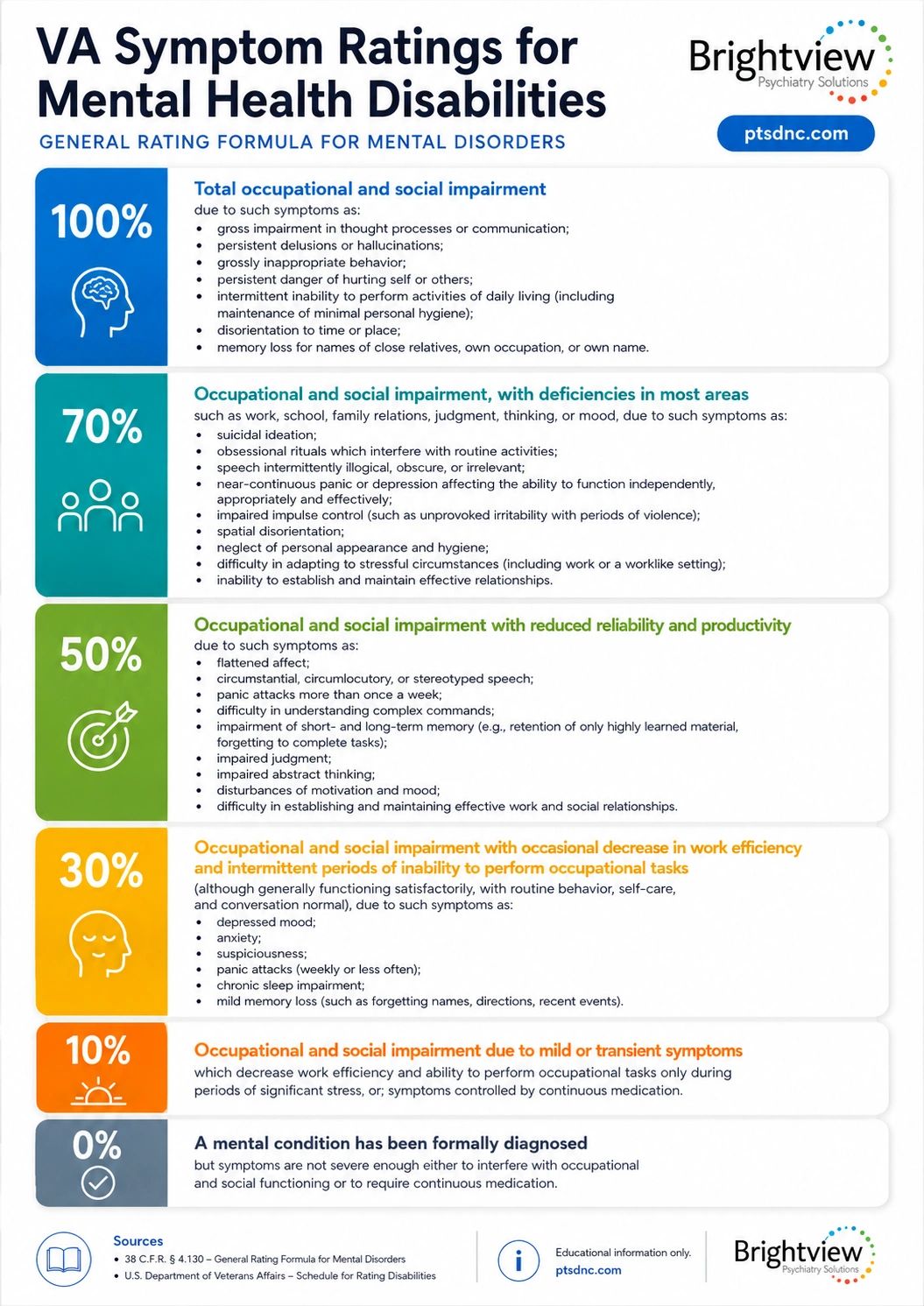
The VA generally rates mental health conditions based on the level of occupational and social impairment, not merely the diagnostic label. In other words, the VA rating is usually based on how the symptoms affect the veteran’s ability to work, interact with others, maintain relationships, function independently, manage stress, and perform daily activities.
This is why two veterans with different diagnoses may receive the same VA rating if their functional impairment is similar. For example, one veteran may be service-connected for PTSD and another may be service-connected for Other Specified Trauma- and Stressor-Related Disorder, yet both may have serious impairment in work, family relationships, mood regulation, sleep, concentration, and social functioning.
The VA commonly evaluates mental health conditions at 0%, 10%, 30%, 50%, 70%, or 100%, depending on severity. A strong VA mental health nexus letter or IME should therefore do more than list a diagnosis. It should clearly explain how the symptoms affect the veteran’s real-world functioning.
Why the Diagnosis Still Matters
Although VA ratings are largely based on impairment, the diagnosis still matters for several reasons.
First, PTSD claims often involve specific stressor-verification rules. The VA may require evidence that the claimed traumatic event occurred, although the rules can vary depending on combat exposure, fear of hostile military or terrorist activity, prisoner-of-war status, military sexual trauma, or other circumstances.
Second, the diagnosis affects the medical rationale. A PTSD nexus letter should usually explain how the veteran meets PTSD criteria and how the symptoms relate to the identified in-service stressor. By contrast, a nexus letter for Other Trauma- and Stressor-Related Disorder may need to explain why the veteran has trauma-related symptoms that are clinically significant even if the full PTSD criteria are not met.
Third, an incorrect or poorly explained diagnosis can create problems during the C&P examination or VA adjudication process. If the VA examiner concludes that the veteran does not meet PTSD criteria, the claim may be denied unless the evidence clearly supports another service-connected mental health diagnosis.
This is one reason a carefully written medical opinion can be important. The opinion should not force a PTSD diagnosis where the criteria are not met. Instead, it should accurately identify the veteran’s condition and explain how the symptoms are connected to service or to a service-connected disability.
PTSD vs. Other Trauma-Related Disorder: Key Differences
.png)
The difference between PTSD and Other Specified Trauma- and Stressor-Related Disorder is primarily clinical.
PTSD requires a specific trauma exposure and a specific pattern of symptoms across multiple categories, including intrusion symptoms, avoidance, negative changes in cognition or mood, and increased arousal or reactivity.
Other Specified Trauma- and Stressor-Related Disorder may be diagnosed when trauma- or stressor-related symptoms are present and clinically significant, but the veteran does not meet the full criteria for PTSD or another specific disorder.
In practical VA claim terms:
- PTSD may be appropriate when the veteran has a qualifying traumatic stressor and meets the full diagnostic criteria.
- Other Specified Trauma- and Stressor-Related Disorder may be appropriate when the veteran has meaningful trauma-related symptoms and impairment, but the full PTSD criteria are not satisfied.
Both conditions can be serious. Both can affect employment, family life, relationships, sleep, concentration, mood, and daily functioning. Both may support a VA disability claim when the medical and factual evidence supports service connection.
If you are in need of a nexus letter for either PTSD or Other Trauma- and Stressor-Related Disorder, or another mental health condition, please visit our booking site.
Common VA Claim Problems Involving PTSD and Trauma-Related Disorders
Veterans may run into several common issues when filing claims for PTSD or other trauma-related mental health conditions.
One common problem is filing specifically for PTSD when the medical evidence supports a different diagnosis. A veteran may sincerely believe they have PTSD, but a clinician may diagnose Other Specified Trauma- and Stressor-Related Disorder, Major Depressive Disorder, Anxiety Disorder, or Adjustment Disorder instead. If the claim is framed too narrowly, important evidence may be overlooked.
Another problem is focusing only on the traumatic event without explaining current impairment. The VA needs to understand not only what happened, but how the veteran is affected now. Symptoms such as sleep disturbance, irritability, avoidance, panic, emotional numbness, concentration problems, marital conflict, workplace issues, and social withdrawal should be clearly documented.
A third problem is weak nexus evidence. A diagnosis alone does not automatically prove service connection. The evidence should explain why the veteran’s current condition is at least as likely as not related to military service or secondary to an already service-connected disability.
Finally, some veterans are denied because the VA examiner states that the veteran does not meet full PTSD criteria. In those cases, it may be important to consider whether the evidence supports another trauma- or stressor-related diagnosis that is still connected to service.
The Role of a Nexus Letter in PTSD and Trauma-Related Disorder Claims
A nexus letter is a medical opinion that explains the connection between a veteran’s current condition and military service, or between the current condition and another service-connected disability.
For PTSD and other trauma-related mental health claims, a strong nexus letter may address:
- The veteran’s current psychiatric diagnosis
- Relevant military stressors or service-related events
- The onset and progression of symptoms
- Current occupational and social impairment
- Consistency between the veteran’s symptoms and the claimed condition
- Relevant medical records, lay statements, and service records
- Whether the condition is at least as likely as not related to service
- Why alternative explanations do or do not account for the veteran’s symptoms
For PTSD, the opinion may also explain how the veteran’s symptoms align with PTSD diagnostic criteria. For Other Specified Trauma- and Stressor-Related Disorder, the opinion may explain why the veteran has clinically significant trauma-related symptoms even though the full PTSD criteria are not met.
The goal is not to guarantee an outcome. The goal is to provide a clear, medically reasoned explanation that helps the VA evaluate the claim accurately.
Can a Veteran Be Rated for More Than One Mental Health Condition?
In many cases, the VA assigns one combined mental health rating based on the overall level of impairment, even if the veteran has multiple psychiatric diagnoses. For example, a veteran may have PTSD, depression, anxiety, and insomnia symptoms, but the VA typically evaluates the overall occupational and social impairment rather than assigning separate ratings for each overlapping mental health diagnosis.
This is why accurate documentation matters. The question is not only “What is the diagnosis?” The question is also “How do all psychiatric symptoms affect the veteran’s ability to function?”
If you are in need of a nexus letter for either PTSD or Other Trauma- and Stressor-Related Disorder, or another mental health condition, please visit our booking site.
What Veterans Should Document
Veterans pursuing a VA disability claim for PTSD or another trauma-related disorder should consider documenting:
- The in-service traumatic or stressful event
- When symptoms began
- How symptoms changed over time
- Mental health treatment history
- Medication history
- Hospitalizations or crisis care, if applicable
- Work problems, absenteeism, reduced productivity, or conflicts
- Relationship problems, divorce, family strain, or isolation
- Sleep impairment, nightmares, panic, anger, avoidance, or hypervigilance
- Statements from spouses, family members, friends, or coworkers
- Prior VA rating decisions and C&P examination findings
The strongest evidence often connects the clinical diagnosis to the veteran’s actual day-to-day limitations.
Final Thoughts
PTSD and Other Trauma- and Stressor-Related Disorder are related but distinct diagnoses. PTSD requires a specific pattern of symptoms following a qualifying traumatic event. Other trauma- and stressor-related disorders may apply when a veteran has clinically significant trauma-related symptoms that do not fully meet PTSD criteria.
For VA disability claims, the diagnosis is important, but the overall evidence is critical. Veterans may be eligible for service connection for PTSD or another mental health condition when the evidence supports a current diagnosis, a service-related cause or aggravating factor, and functional impairment.
A well-supported VA mental health claim should accurately identify the diagnosis, explain the nexus to service or to a service-connected condition, and clearly describe how symptoms affect occupational and social functioning.
For veterans who have experienced trauma or chronic stress during military service, the absence of a PTSD diagnosis does not necessarily mean the absence of a valid VA mental health claim. The key is making sure the medical evidence accurately reflects the veteran’s condition and explains the connection in a way the VA can properly evaluate.
If you are in need of a nexus letter for either PTSD or Other Trauma- and Stressor-Related Disorder, or another mental health condition, please visit our booking site.
______________
About the Author: Dr. Jessica Allen
Dr. Jessica Allen is a psychiatrist and M.D. who has extensive experience evaluating veterans with complex trauma-related psychiatric presentations, including cases where the diagnosis is not as straightforward as PTSD. As a former Compensation and Pension examiner, Dr. Allen understands that many veterans develop serious psychiatric symptoms after military trauma or chronic service-related stress, yet may not always meet the full diagnostic criteria for PTSD. In those cases, diagnoses such as Other Specified Trauma- and Stressor-Related Disorder, Adjustment Disorder, anxiety, depression, or insomnia may more accurately capture the veteran’s clinical picture.
This distinction is especially important in VA disability claims because veterans are often denied or misunderstood when a claim is framed only as PTSD, even though the evidence may support another service-connected mental health diagnosis. Dr. Allen’s psychiatric training allows her to carefully evaluate whether a veteran’s symptoms satisfy DSM-5 criteria for PTSD or whether another trauma- or stressor-related diagnosis is more clinically appropriate.
Through PTSDNC.com and Brightview Psychiatry Solutions, Dr. Allen prepares medical nexus letters that focus on diagnostic accuracy, service connection, and functional impairment. Her opinions are informed by clinical psychiatry, experience with the VA disability evaluation process, and careful review of each veteran’s records, service history, lay statements, symptom progression, and occupational and social limitations.
Dr. Allen’s work is particularly valuable in claims involving diagnostic complexity — for example, when a veteran has trauma-related symptoms but does not meet full PTSD criteria, when a prior C&P examination minimizes symptoms, or when the VA overlooks the relationship between military stressors and a non-PTSD mental health diagnosis. Her goal is to provide a clear, medically reasoned opinion that helps explain the veteran’s condition in terms the VA can evaluate.
To schedule a free phone consultation with Dr. Allen, please visit our booking site.