
Sleep Apnea Secondary to Sinusitis
Author: Jessica Allen, M.D.
Sleep Apnea Secondary to Sinusitis: What Veterans Should Know About VA Disability Claims
Many veterans live with chronic sinusitis after military exposures to burn pits, dust, sand, smoke, airborne irritants, or other environmental hazards. For some veterans, sinusitis causes more than congestion, facial pressure, drainage, headaches, and difficulty breathing through the nose. Chronic sinus problems may also contribute to, worsen, or complicate obstructive sleep apnea.
If you are already service-connected for sinusitis and have been diagnosed with obstructive sleep apnea, you may be able to pursue a VA disability claim for sleep apnea secondary to sinusitis. However, the VA usually requires more than simply showing that both conditions exist. The key issue is whether the medical evidence explains how the service-connected sinusitis caused, contributed to, or aggravated the sleep apnea.
A well-written medical nexus letter can help bridge that gap.
Schedule a Free Phone Consultation with Dr. Allen to Discuss Your Case: Consultation Booking
Can Sleep Apnea Be Claimed Secondary to Sinusitis?
Yes, sleep apnea may be claimed as secondary to sinusitis when the facts and medical evidence support a connection.
Obstructive sleep apnea, or OSA, occurs when the upper airway repeatedly narrows, collapses, or becomes blocked during sleep. This can lead to loud snoring, witnessed pauses in breathing, gasping or choking at night, morning headaches, non-restorative sleep, daytime fatigue, poor concentration, irritability, and cardiovascular strain.
Sinusitis involves inflammation of the sinus passages. Chronic sinusitis may cause persistent nasal congestion, mucus obstruction, postnasal drip, facial pain, impaired nasal airflow, and difficulty breathing through the nose. When nasal airflow is chronically impaired, a veteran may experience increased airway resistance during sleep, increased mouth breathing, worsened snoring, fragmented sleep, and difficulty tolerating CPAP or other PAP therapy.
For VA purposes, the important question is not merely whether sinusitis and sleep apnea coexist. The question is whether the veteran’s service-connected sinusitis at least as likely as not caused or aggravated the veteran’s obstructive sleep apnea.
Schedule a Free Phone Consultation with Dr. Allen to Discuss Your Case: Consultation Booking
How Sinusitis May Worsen Obstructive Sleep Apnea
The nose, sinuses, throat, and upper airway all work together during breathing. When chronic sinusitis causes ongoing congestion, inflammation, drainage, or nasal obstruction, it may place additional stress on the upper airway during sleep.
Sinusitis may not always be the original cause of sleep apnea. In some cases, the stronger medical argument is that sinusitis aggravates sleep apnea by worsening nighttime breathing, increasing symptom burden, or interfering with effective treatment.
Schedule a Free Phone Consultation with Dr. Allen to Discuss Your Case: Consultation Booking
What the VA Usually Looks for in a Secondary Claim
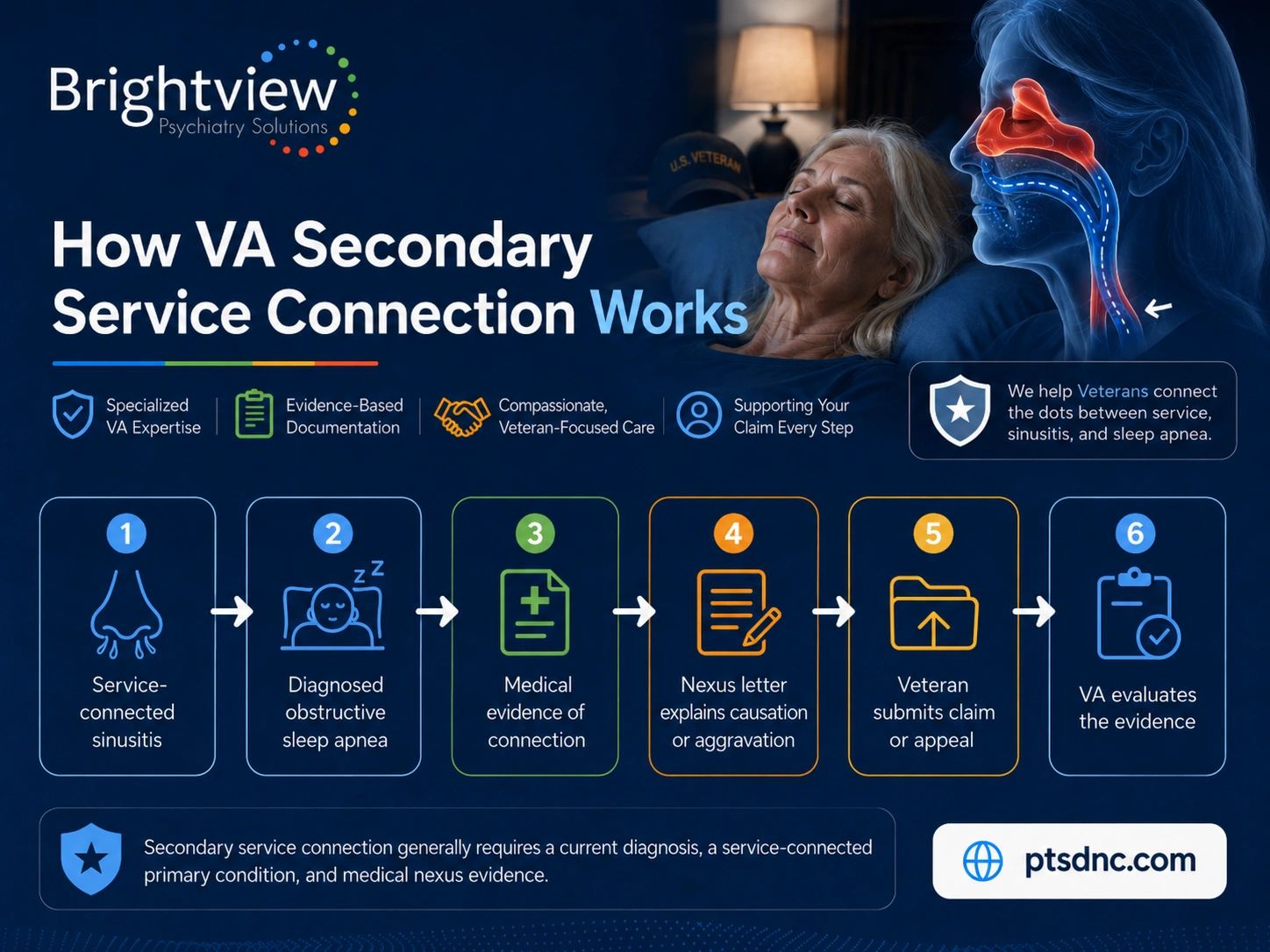
To support a claim for sleep apnea secondary to sinusitis, veterans generally need three categories of evidence.
First, the VA typically requires a current diagnosis of obstructive sleep apnea. This is usually confirmed by a sleep study, either through an in-lab polysomnography or a home sleep apnea test. Records should identify the diagnosis, severity, and whether treatment such as CPAP, APAP, BiPAP, or an oral appliance has been prescribed.
Second, the veteran needs a service-connected primary condition. In this type of claim, the primary condition is usually chronic sinusitis. The veteran may already be service-connected for sinusitis or may be pursuing service connection for sinusitis at the same time.
Third, the veteran needs a medical nexus. This is often the most important part of the claim. The nexus opinion should explain why the veteran’s sleep apnea is at least as likely as not proximately due to, the result of, and/or aggravated by the service-connected sinusitis. A strong nexus letter should not rely on a generic statement that “sinusitis can cause sleep apnea.” It should explain how the veteran’s specific symptoms, timeline, sleep study findings, treatment history, risk factors, and functional impairments fit together medically.
Schedule a Free Phone Consultation with Dr. Allen to Discuss Your Case: Consultation Booking
Causation vs. Aggravation
There are two major ways to evaluate sleep apnea secondary to sinusitis: causation and aggravation.
Causation means the service-connected sinusitis directly contributed to the development of obstructive sleep apnea. This may be relevant when a veteran had longstanding sinus symptoms, chronic nasal obstruction, mouth breathing, snoring, witnessed apneas, and sleep disruption before or around the time OSA was diagnosed.
Aggravation means the sinusitis made the sleep apnea worse, even if other factors also contributed to the original development of OSA. This theory may be important when chronic sinus congestion worsens nighttime breathing, increases awakenings, makes PAP therapy harder to tolerate, or increases the functional impact of sleep apnea symptoms.
In many VA claims, aggravation is especially important because the VA may focus heavily on other risk factors such as age, anatomy, or obesity. A well-supported nexus letter should address whether sinusitis caused the sleep apnea, aggravated the sleep apnea, or both.
What Evidence Can Help Support the Claim?
Helpful evidence may include sleep study results, a diagnosis of obstructive sleep apnea, CPAP or BiPAP prescriptions, PAP compliance reports, and records documenting mask intolerance, pressure intolerance, or congestion-related difficulty using treatment.
Sinusitis-related evidence may include VA rating decisions, ENT records, sinus CT scans, documentation of chronic sinusitis or chronic rhinosinusitis, recurrent sinus infections, antibiotic use, nasal sprays, antihistamines, decongestants, nasal rinses, and records showing nasal obstruction, postnasal drip, purulent drainage, headaches, facial pain, or sinus tenderness.
Lay statements may also be helpful. A spouse, family member, roommate, or fellow service member may be able to describe loud snoring, pauses in breathing, gasping, choking, chronic congestion, mouth breathing, daytime fatigue, worsening sleep during sinus flare-ups, or problems using CPAP because of nasal blockage.
What If the VA Denies the Claim?
VA may deny sleep apnea secondary to sinusitis claims when the evidence does not clearly explain the medical connection between the two conditions. Common denial reasons include findings that there is no nexus, that obesity or another risk factor is the more likely cause, that sinusitis and sleep apnea are separate conditions, or that the submitted medical opinion is too brief or conclusory. The VA may also deny claims when the argument focuses only on causation and does not address aggravation.
If your claim has already been denied, it is important to review the VA decision letter carefully. In many cases, a veteran may be able to file a Supplemental Claim with new and relevant evidence. A detailed nexus letter may serve as new and relevant evidence when it directly addresses the reason the VA denied the claim and provides a clear, individualized medical explanation.
Because deadlines can affect appeal options and potential effective dates, veterans should pay close attention to the date on the VA decision letter.
Has Your Claim for OSA Secondary to Sinusitis Been Denied? Schedule a Free Phone Consultation with Dr. Allen to Discuss Your Case: Consultation Booking
What About Obesity?
The VA often cites obesity as a risk factor when denying obstructive sleep apnea claims. While obesity is a known risk factor for OSA, it does not automatically rule out sinusitis as a contributing or aggravating factor. Sleep apnea can have multiple contributing causes.
A strong medical opinion should address obesity directly and carefully. The opinion should explain whether sinusitis caused or aggravated OSA despite other risk factors, whether sinusitis worsened PAP tolerance, and whether the veteran’s overall medical history supports a secondary service connection theory.
In some cases, obesity may also be relevant as an “intermediate step” between service-connected disabilities and sleep apnea. For example, if service-connected conditions limit activity, disrupt sleep, worsen fatigue, or contribute to weight gain, and that weight gain contributes to OSA, this may require careful medical analysis.
The key question is not whether the veteran has other risk factors. The key question is whether the evidence shows that a service-connected condition was at least as likely as not part of the causal or aggravating pathway.
Do Veterans Need a Nexus Letter?
In many cases, yes. A nexus letter can be especially important when VA has denied the claim, when there are multiple risk factors, or when the medical connection between sinusitis and sleep apnea needs to be explained in a clear, individualized way.
A strong nexus letter should review the veteran’s records, discuss the timeline of symptoms, address sleep study findings, consider sinusitis severity, evaluate PAP tolerance, discuss relevant risk factors, and explain how the medical literature applies to the veteran’s specific case.
Medical articles alone are often not enough. The VA may consider general research too broad unless a qualified medical professional explains how that research applies to the veteran’s particular history.
Ready to Get Your Nexus Letter? Schedule a Free Phone Consultation with Dr. Allen to Discuss Your Case: Consultation Booking
Final Thoughts
Veterans who are service-connected for sinusitis and later develop obstructive sleep apnea may have a medically supportable basis for a secondary service connection claim. However, these claims are highly fact-specific. The strongest claims usually include a confirmed sleep apnea diagnosis, evidence of chronic sinusitis, documentation of nasal obstruction or treatment difficulty, lay statements when appropriate, and a detailed medical nexus opinion.
At Brightview Psychiatry Solutions, Dr. Allen provides independent medical nexus letters for veterans pursuing VA disability claims, including claims involving obstructive sleep apnea secondary to sinusitis, rhinitis, PTSD, depression, anxiety, chronic pain, and other service-connected conditions.
If you have been diagnosed with obstructive sleep apnea and are service-connected for sinusitis, Brightview Psychiatry Solutions may be able to help you evaluate whether a nexus opinion is medically appropriate for your claim.
Schedule a consultation: https://intakeq.com/booking/ioezdg
Related Pages:
Visit Our Sleep Apnea Webpage: Sleep Apnea Claims
Visit Our Website Dedicated Fully to VA Sleep Apnea Claims: Sleepapneanexusletters.com
Read Our Blog About Claiming Sleep Apnea Secondary to Rhinitis: OSA and Rhinitis Blog
Read Our Blog About Claiming Sinus Headaches Secondary to Sinusitis: Sinus Headaches Secondary to Sinusitis
__________
About the Author
Dr. Jessica Allen, M.D., is a physician and former Compensation & Pension (C&P) examiner with extensive experience evaluating veterans for VA disability claims. Through Brightview Psychiatry Solutions, she provides independent medical nexus letters and psychological evaluations for veterans seeking to document the relationship between service-connected conditions and secondary medical or mental health disabilities.
Dr. Allen has years of experience working with disability claims and understands the medical-legal standards used by the Department of Veterans Affairs, including the importance of the “at least as likely as not” evidentiary threshold. Her background as a former C&P examiner gives her direct insight into how VA medical opinions are reviewed, why claims are often denied, and what type of medical rationale is needed to support service connection.
Dr. Allen regularly writes nexus letters involving obstructive sleep apnea, including claims where sleep apnea is secondary to PTSD, depression, anxiety, insomnia, chronic pain, rhinitis, sinusitis, asthma, medication effects, and obesity as an intermediate step. Her opinions are grounded in a careful review of the veteran’s medical records, service-connected conditions, symptom history, sleep study findings, treatment records, and relevant medical literature.
Because sleep apnea claims are often complex and frequently denied due to competing risk factors such as age, weight, anatomy, or smoking history, Dr. Allen focuses on providing clear, individualized, evidence-based medical explanations. Her goal is to help veterans pursue the VA benefits they may be entitled to by presenting a thorough, medically reasoned nexus opinion that addresses causation, aggravation, and the veteran’s specific clinical history.
Schedule a Free Phone Consultation with Dr. Allen to Discuss Your Case: Consultation Booking